Carbon Reduction Plan
Supplier name: McConnell Group
Publication date: 01/07/2026
Commitment to achieving Net Zero
McConnell is committed to achieving Net Zero emissions by 2050 for its UK operations.
Baseline Emissions Footprint
Baseline emissions are a record of the greenhouse gases that have been produced in the past year and were produced prior to the introduction of any strategies to reduce emissions. Baseline emissions are the reference point against which emissions reduction can be measured.
Baseline year: May 2024 – April 2025
Additional details relating to the baseline emissions calculations
McConnell’s baseline year is FY25, covering the period 1st May 2024 to 30th April 2025. This was the company’s first reported carbon baseline, introducing Scope 1, Scope 2 and Scope 3 business travel emissions.
The FY25 baseline remains the reference point for Scope 1, Scope 2 and previously reported Scope 3 business travel emissions. In FY26, McConnell expanded its reporting boundary to include all five Scope 3 categories required under PPN 006: upstream transportation and distribution, waste generated in operations, business travel, employee commuting, and downstream transportation and distribution.
As these additional Scope 3 categories were not reported in FY25, the Scope 3 baseline has been reset from FY26 for the expanded Scope 3 boundary. This provides a complete and consistent basis for future Scope 3 comparison.
|
FY25 |
||
| Scope / Category | Emission source | FY2024/25 tCO2e |
| Scope 1 – Direct emissions | Natural gas | 4.57 |
| Stationary combustion | 54.02 | |
| Mobile combustion | 529.35 | |
| Scope 1 subtotal | 587.94 | |
| Scope 2 – Purchased electricity | Electricity | 42.53 |
| Scope 2 subtotal | 42.53 | |
| Scope 3 – Reported categories | Waste generated in operations | n/a |
| Business travel | 164.79 | |
| Upstream transportation and distribution | n/a | |
| Employee commuting | n/a | |
| Downstream transportation and distribution | n/a | |
| Scope 3 subtotal | 164.79 | |
| Total reported emissions | 795.26 | |
Current emissions reporting
Reporting year: May 2025 – April 2026
The current reporting year covers the period 1st May 2025 to 30th April 2026. Current emissions include Scope 1, Scope 2 and the five Scope 3 categories required under PPN 006.
Scope 3 included sources are:
- Category 4: Upstream Transportation and Distribution
- Category 5: Waste Generated in Operations
- Category 6: Business Travel
- Category 7: Employee Commuting
- Category 9: Downstream Transportation and Distribution
Scope 3 Category 9, Downstream Transportation and Distribution, has been assessed as not applicable and reported as 0.00 tCO2e. McConnell is a building contractor and does not sell physical products requiring downstream distribution to end consumers. Works are delivered on site, and any transport arranged or paid for by McConnell is captured under Scope 1 mobile combustion, business travel, waste, or upstream transportation and distribution.
Current reporting year emissions
|
FY26 |
||
| Scope / Category | Emission source | FY2025/26 tCO2e |
| Scope 1 – Direct emissions | Natural gas | 9.54 |
| Stationary combustion | 142.99 | |
| Mobile combustion | 968.47 | |
| Scope 1 subtotal | 1,120.99 | |
| Scope 2 – Purchased electricity | Electricity | 52.42 |
| Scope 2 subtotal | 52.42 | |
| Scope 3 – Reported categories | Waste generated in operations | 1,558.68 |
| Business travel | 71.89 | |
| Upstream transportation and distribution | 512.62 | |
| Employee commuting | 896.01 | |
| Downstream transportation and distribution | 0.00 | |
| Scope 3 subtotal | 3039.20 | |
| Total reported emissions | 4212.62 | |
Emissions reduction targets
McConnell is committed to achieving Net Zero emissions by 2050.
To continue progress towards Net Zero, McConnell has adopted an interim target to reduce emissions over the next five years, subject to a consistent reporting boundary and comparable business activity.
McConnell’s formal baseline year remains FY25, with total reported baseline emissions of 795.26 tCO2e. FY26 will be used as the baseline for the expanded Scope 3 reporting boundary.
For the full FY26 reported footprint, total emissions were 4,212.62 tCO2e. McConnell aims to reduce this footprint by 10% over the next five years, reducing emissions to approximately 3,791.36 tCO2e by FY31. This represents a reduction of approximately 421.26 tCO2e.
Progress against this target will be measured against a consistent reporting boundary, subject to comparable business activity and improvements in data quality over time.
McConnell Projected Carbon Reduction
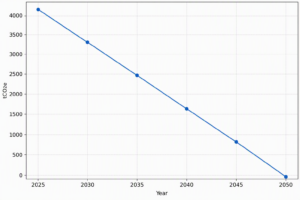
*Projection starts from FY26 because this is the first year with the expanded Scope 3 reporting boundary
On a comparable reporting basis, emissions still increased between FY25 and FY26. Scope 1 and Scope 2 emissions increased from 630.47 tCO2e to 1,173.42 tCO2e, mainly due to higher reported mobile and stationary fuel use.
The full reported footprint also increased because FY26 includes all five required Scope 3 categories for the first time. This more comprehensive boundary provides a more transparent basis for future comparison and reduction planning.
McConnell will also monitor emissions intensity, measured as tCO2e per £ million turnover, to assess performance in the context of business growth and operational activity.
Carbon reduction projects
Completed carbon reduction projects
The following environmental management measures and projects have been completed or implemented since the 2025 baseline.
- Environmental management – maintained ISO 14001-supported environmental management processes.
- Carbon data collection – strengthened monthly data capture and live reporting through the Goodsted ESG reporting platform.
- CARE Impact ESG strategy – launched McConnell’s ESG strategy, CARE Impact, introducing site-based ESG initiatives.
- Scope 3 reporting – expanded reporting to include the five PPN 006 Scope 3 categories.
- Local procurement – prioritised local suppliers within 20 miles.
- Travel controls – continued virtual meetings and controlled travel planning.
- Office and site energy use – continued focus on eco cabins, lighting controls and energy awareness.
- Fleet review – reviewed fleet efficiency and increased EV/PHEV uptake where operationally suitable.
McConnell has not claimed an overall carbon reduction against the FY25 baseline, as total reported emissions increased in FY26 due to the expanded PPN 006 Scope 3 boundary. Reported Scope 3 Category 6 business travel emissions decreased from 164.79 tCO2e to 71.89 tCO2e, a reduction of 92.9 tCO2e, or 56.37%. However, this reduction should be treated with caution, as the FY25 figure may have been overstated and FY26 reflects improved data review and classification. Other completed measures have not been separately quantified at project level; their impact is reflected within McConnell’s annual energy, fuel, travel and waste data.
Future carbon reduction initiatives
The following initiatives are kept at a high level at this stage to reflect McConnell’s key emissions hotspots and planned areas of focus.
- Waste treatment evidence – request clearer recycling, recovery, landfill and energy-from-waste data from waste contractors.
- Fleet and mobile fuel use – review fleet replacement options, including lower-emission, EV and PHEV vehicles where operationally practical.
- Employee commuting data – complete a staff travel survey to improve commuting assumptions and identify reduction opportunities.
- Supplier transport data – improve upstream transportation data, including delivery mileage, vehicle type, delivery frequency and tCO2e-kilometre data.
- Stationary combustion – review fuel use from generators, fixed equipment and site plant to identify reduction opportunities.
- Office energy – review electricity and natural gas use and identify efficiency improvements.
- Business travel controls – continue virtual meetings and efficient journey planning to reduce avoidable travel.
- Carbon data governance – strengthen internal processes for collecting, checking and approving fuel, energy, waste, travel, commuting and supplier data.
Governance and accountability
Responsibility for carbon reporting sits with the Environmental and Sustainability Advisor, who maintains the reporting workbook, completes the emissions calculations and prepares the SECR and Carbon Reduction Plan. Reporting data is provided by relevant internal teams, including fleet, finance and procurement, covering fuel, energy, waste, travel, commuting and supplier information.
Delivery of future carbon reduction actions will sit with the operational teams responsible for each area. This includes fleet-related actions being supported by the fleet team, supplier and procurement actions by the procurement team, and energy, waste and site-based actions by the relevant operational and project teams.
Declaration and sign off
This Carbon Reduction Plan has been completed in accordance with PPN 006 and associated guidance and reporting standard for Carbon Reduction Plans.
Emissions have been reported and recorded in accordance with the published reporting standard for Carbon Reduction Plans and the GHG Reporting Protocol corporate standard13 and uses the appropriate government emission conversion factors for greenhouse gas company reporting.
Scope 1 and Scope 2 emissions have been reported in accordance with SECR requirements , and the required subset of Scope 3 emissions have been reported in accordance with the published reporting standard for Carbon Reduction Plans and the Corporate Value Chain (Scope 3) Standard.
This Carbon Reduction Plan has been reviewed and signed off by the board of directors.
Signed on bahalf of the supplier
Simon Lacey
Managing Director (England)

02/09/2026